How to Build Financial Resilience in Uncertain Times
Uncertainty is nothing new — but for retirees, it can feel more personal. When you’re no longer earning a paycheck, everything from rising prices to market swings can impact how secure and steady your retirement income feels. The good news? Financial resilience gives you a sense of stability, no matter what the economy, headlines, or markets are doing.
Financial resilience isn’t about predicting the future.
It’s about creating a retirement that stays steady, flexible, and confident through every economic season. It means having a plan that supports your lifestyle, protects your income, and reduces the need to make emotional decisions when the world feels uncertain.
This guide breaks down what financial resilience really is, why it matters, and the simple steps you can take to strengthen your retirement — whether you live in Florida, California, Texas, or anywhere else in the country.
What Is Financial Resilience?
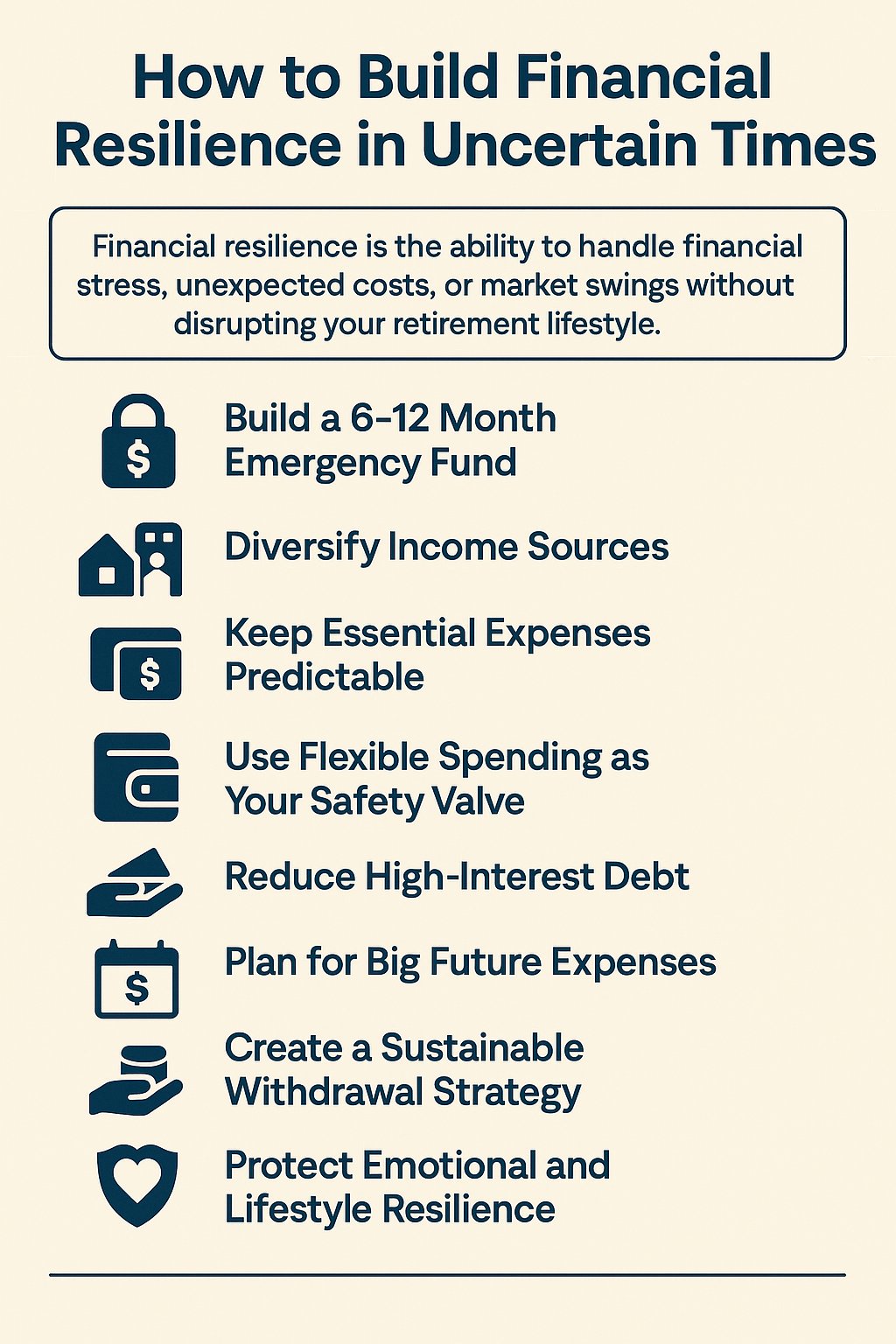
Financial resilience is your ability to handle financial stress, unexpected expenses, or market changes without disrupting your retirement lifestyle.
It’s not about having the biggest nest egg.
It’s about ensuring the nest egg you do have is secure, flexible, and built to last.
A financially resilient retiree can:
- Maintain steady income even when markets move
- Handle medical bills or home repairs without panic
- Adjust spending if prices rise
- Make decisions calmly instead of emotionally
- Adapt their plan when life changes unexpectedly
Think of financial resilience as your retirement “shock absorbers.” You still feel bumps — but you’re protected from the jolt.
Why Financial Resilience Matters in Retirement
Financial resilience matters because retirement comes with unique challenges:
-
Income becomes more fixed.
You aren’t earning a paycheck anymore. -
Unexpected costs become more common.
Medical issues, home repairs, travel to help family — all can hit without warning. -
Markets can’t be controlled.
But you can control how exposed you are to them. -
Costs vary depending on where you live.
Taxes, insurance, housing, and healthcare differ from state to state.
Without a resilience plan, retirees often feel:
- Uncertain during market drops
- Worried about inflation
- Afraid to overspend
- Overwhelmed by unexpected bills
With strong resilience, you feel:
- Stable
- Confident
- Flexible
- Protected
- Calm
The 8 Steps to Build Retiree Financial Resilience
1. Build a 6–12 Month Emergency Fund
A retirement emergency fund protects you from financial surprises.
How much should retirees keep in emergency savings?
Many retirees feel secure with 6 to 12 months of essential expenses set aside. But your ideal number depends on your cost of living, local prices, and health needs.
What should the emergency fund cover?
- Home repairs
- Medical bills
- Major car repairs or replacements
- Travel to handle family matters
- Sudden expense spikes
This prevents you from withdrawing from savings or selling investments at the wrong time.
2. Diversify Your Income Sources
When one income source feels shaky, others help keep your retirement steady.
Common sources for retirees include:
- Social Security
- Pension income
- Savings withdrawals
- Part-time work
- Rental income
- Steady, predictable income sources (general concept only)
Q: Why is diversified income important?
A: It reduces your reliance on any single source and helps maintain stability during market swings, inflation, or rising local costs.
3. Keep Essential Expenses Predictable
Predictability equals peace of mind.
Your essential expenses include:
- Housing
- Food
- Utilities
- Healthcare
- Insurance
- Transportation
Ways to increase predictability:
- Choose stable-rate services when possible
- Reduce debt
- Estimate healthcare needs annually
- Build in a buffer for rising costs
Predictable expenses protect your lifestyle — even when outside forces fluctuate.
4. Use Flexible Spending as Your Safety Valve
Your retirement budget should breathe with you.
The best way to do this is with three spending categories:
- Must-haves — essentials
- Nice-to-haves — flexible lifestyle spending
- Could-wait items — optional purchases
When markets or prices shift, you adjust category #2 or #3, not your essentials.
Q: How does flexible spending increase resilience?
A: It allows you to adapt without stress or major disruptions.
5. Reduce High-Interest Debt
High-interest debt drains your income and reduces your flexibility.
Paying it down provides:
- Lower monthly expenses
- More cash flow
- Less strain on savings
- Better long-term stability
- Fewer surprises when interest rates rise
Small steps create immediate relief.
6. Plan for Big Future Expenses
Big expenses shouldn’t feel like financial emergencies.
Examples:
- Roof replacements
- Appliances
- Car replacements
- Major health needs
- Helping a family member
Q: How does planning ahead help retirees?
A: It spreads future costs over time, preventing large one-time hits to your savings.
7. Create a Sustainable Withdrawal Approach
A sustainable withdrawal rhythm keeps your savings lasting longer.
This means:
- Withdrawing with purpose
- Avoiding emotional changes
- Adjusting when the economy shifts
- Keeping income steady while managing risk
Q: Should retirees lower withdrawals during market downturns?
A: Some choose to temporarily reduce flexible spending, not essentials. Your approach depends on your goals and comfort level.
8. Strengthen Your Emotional and Lifestyle Resilience
Financial resilience isn’t only about money — it’s about stability in all areas.
Strong resilience includes:
- Emotional well-being
- Social connection
- Mental clarity
- Purpose in daily life
- Healthy routines
Good decisions come from a clear mind, not a stressed one.
Q&A: Fast Answers for Retirees
Q: What is the biggest risk to financial resilience?
A: Unplanned expenses or emotional decisions during market swings.
Q: Is it too late to build resilience if I’m already retired?
A: Never. Even small adjustments create real protection.
Q: Does inflation affect all retirees equally?
A: No — costs vary by state, region, and lifestyle. Planning ahead helps you stay ahead.
 Tootsie’s Takeaway
A steady retirement is a lot like a good nap spot — safe, cushioned, and ready for anything. Build a strong foundation now, and you’ll enjoy every season with more peace of mind.
Written by Brent Meyer, founder of SafeMoney.com. With more than 20 years of experience helping families navigate retirement and legacy planning, Brent is committed to making financial education simple, clear, and trustworthy.
Disclaimer: SafeMoney.com provides financial education only. For guidance on your specific situation, consult a licensed professional.
The post How to Build Financial Resilience in Uncertain Times first appeared on SafeMoney.com.
Featured Blogs
- Estate Planning: More Than Just a Simple Will
- Safe Money vs Market Risk: Why Retirees Choose Protection
- Avoid Early Failures in Retirement Planning
- How Much Income Can $1 Million Really Generate?
- Can You Retire at 60 with $1 Million?
- Your Guide to Long-Term Care Planning
- Harnessing the Luck of the Irish for Your Retirement 🐾
- Honoring Women Advisors for National Women's Month
- Retiring During a Bear Market: What to Know
- The Biggest Retirement Tax Mistakes to Avoid
- Roth Conversions Before RMDs: Smart Tax Strategy?
- Mastering Roth IRA Conversions for Retirement Success
- Are You Paying Retirement Taxes You Don’t Have To?
- Annuities and the Peak65 Explosion
- Financial Trends of 2026: Advisors Play Critical Role
- Inflation Is Fueling Retirement Fears in 2026
- Social Security Survivor Benefits Explained for Couples
- Don't Let Unexpected Retirement Expenses Catch You Off Guard
- Annuities: Embracing the 'Safe Growth' Trend
- Will Social Security Run Out? 2026 Update
- Life Insurance: The Income Bridge Many Couples Miss
- What Happens to Your Income When One of You Is Gone?
- A Paws-On Approach to Understanding Medicare Basics 🐾
- Love Isn’t Just a Feeling—It’s a Retirement Plan
- Understanding Fixed Index Annuities in Today's Market
- Secure Retirement Plans: Annuities & Longevity Strategies
- New Tools, Same Goals: How Retirement Planning Is Evolving 🐾
- Why Market Volatility Hits Retirees Harder Than Workers
- Annuities: Your Forever Treat Bowl in Retirement 🐾
- The Retirement Paycheck: How to Replace Your Salary in Retirement
- Secure Your Retirement with Safe Income Strategies
- 3 Biggest Retirement Income Mistakes After 50
- Why Retirement Income Matters More Than Account Savings
- What Financial Awareness Really Means in Retirement
- Having Savings Isn’t the Same as Having a Plan
- The Secret to Retirement Confidence Is Structure, Not Luck
- What Retirees Should Review Before the New Year
- Preparing Your Retirement Income for the Year Ahead
- 🎾 Fetch Calm, Not Chaos: Keeping Retirement Income Steady
- Missed Medicare Open Enrollment? What Retirees Can Do Now
- Missed Medicare Open Enrollment? What Retirees Can Do Now
- game
- potatoes
- Staying Calm in December Markets: A Bulldog’s Guide to Balance
- Why December Is Ideal for Securing Lifetime Income
- December Medicare Checkup: What to Review Before Jan 1
- 5 Year-End Retirement Blind Spots to Avoid in 2025
- Your December Retirement Checkup Guide
- Black Friday Savings Tips Retirees Can Use This Holiday
- The Retirement Spending Smile Explained
- A Thanksgiving Lesson in Gratitude, Guidance & Guaranteed Income
- Give Thanks, Then Revisit Your Retirement Plan
- blogging
- How to Build Financial Resilience in Uncertain Times
- Smart Charitable Giving Before Year-End
- Understanding RMDs: What Every Retiree Needs to Know Before Age 73
- The Retirement Income Gap: Will Your Money Last?
- The Psychology of Retirement: Aligning Money and Mindset
- The 3-Bucket Plan for Calm Cash Flow
- How to Stress-Test Your Retirement Plan
- Why a Year-End Portfolio Review Could Save Your Retirement
- 4 Retirement Myths That Can Cost You Big Time
- Is Your Medicare Specialist on the Calendar Yet?
- The Retirement Tax Trap: Moves to Make Before Year-End
- How to Use Catch-Up Contributions to Boost Your Retirement
- Why Retirement Financial Literacy Matters More Than Ever
- Why Guaranteed Lifetime Income Is Your Next Big Priority
- Your Year-End Financial Planning Checklist for 2026
- The Hidden Link Between Health Costs and Retirement Security
- The Hidden Link Between Health Costs and Retirement Security
- Tootsie Tuesday Starts Nov. 4—Stay Tuned!
- Keeping Your Financial Plan on Track After Retirement
- Medicare Open Enrollment Starts Today: What You Need to Know
- Protect What You’ve Built: Managing Risk in Retirement
- Protect What You’ve Built: Managing Risk in Retirement
- Turning Savings Into Income: Your Lifetime Paycheck Plan
- The Cost of Waiting: Don’t Delay Your Financial Plan
- How to Calculate Your Retirement Income Gap (Why It Matters)
- October Is National Financial Planning Awareness Month
- The Great Wealth Transfer: Baby Boomers Passing Trillions
- Permanent vs. Term Life Insurance: What’s the Difference?
- One Big Beautiful Bill: What Retirees Need to Know
- One Big Beautiful Bill: What Retirees Need to Know
- The Role of Life Insurance in a Comprehensive Retirement
- IUL Insurance Explained: Pros, Cons, and Misconceptions
- The Role of Life Insurance in Estate Planning
- Tax Advantages of Life Insurance You May Not Know
- Using Life Insurance to Protect Retirement Income
- 5 Life Insurance Myths That Could Cost Your Family
- Life Insurance vs. Annuities: Key Differences Explained
- How Much Life Insurance Do You Really Need?
- Life Insurance Awareness Month: Why It Matters in 2025
- What to Do After You’ve Made Your Will or Trust
- TOD, POD & Beneficiaries: Tools to Avoid Probate
- Passing Down More Than Money: Letters & Legacy Planning
- The Hidden Risks of DIY Wills and How to Avoid Them
- Probate Explained: What It Is and How to Avoid It
- Naming Beneficiaries: The Hidden Danger of Getting It Wrong
- Spotlight Series: Michael Dinich of Your Money Matters, Inc.
- From Retirement Ready to Legacy Ready: What Comes Next?
- What’s Your Retirement Goal—and Are You on Track?
- How Inflation Quietly Erodes Your Retirement Income
- Peace of Mind in Retirement Starts With a Plan
- Avoiding Retirement Surprises Most People Miss
- How Social Security Timing Impacts Retirement Income
- Smart Tax Moves That Boost Retirement Income Longevity
- Spotlight Series Interview with Paul R. Lowe
- Avoiding Market Risks in Retirement: Why It Matters
- How to Create a Retirement Paycheck That Lasts
- Blogg
- deployed the changes to staging
- Testing web blog publication
- blog checking
- test blog not creation issue in sub agents
- Here test
- Cluck Norris
- testing duplicate blog publisher issue
- Reproduce duplicate posting issue
- Testing long running worker
- testing web blog changes (Copy)
- testing with force unlock
- teting
- New capabilities to manage On-Demand Capacity Reservations
- Additional instance types supported for Credential Guard
- AMI deregistration protection
- Added Nitro performance considerations for enhanced networking
- Set IMDSv2 as the account default
- Tag new Linux AMIs created from a snapshot
- Tag new AMIs and snapshots when copying
- EC2 Instance Connect preinstalled on macOS AMIs
- EC2 Instance Connect support for CentOS, macOS, and RHEL
- Amazon Q EC2 instance type selector
- EC2 Free Tier
- Console-to-Code
- Configurable idle connection tracking timeouts
- VolumeStalledIOCheck metric
- PTP hardware clock
- Change instance type of instance enabled for hibernation
- Amazon Data Lifecycle Manager default policies
- Amazon EBS snapshot lock
- Instance topology
- Block public access for snapshots
- Amazon Data Lifecycle Manager pre and post scripts
- AWSDataLifecycleManagerSSMFullAccess AWS managed policy
- Capacity Blocks for ML
- Spot Instance hibernation
- Default settings for block public access for AMIs
- Amazon EC2 Global View
- Disable an AMI
- Attached EBS status checks
- Block public access to AMIs
- EC2 Instance Connect Endpoint
- IMDS Package Analyzer
- EC2 Serial Console bare metal instances
- Launch template quotas
- Capacity Reservation utilization notifications
- Amazon EBS performance updates
- Capacity Reservation groups
- Modify instance metadata options
- In-place macOS operating system updates
- UEFI preferred
- Fault testing on Amazon EBS
- AMI alias in launch templates
- Hibernation support for C6i, I3en, and M6i
- Torn write prevention
- ENA Express
- Recycle Bin retention rule lock
- Copy AMI tags
- AMI size for store and restore
- priceCapacityOptimized allocation strategy for Spot Instances
- price-capacity-optimized allocation strategy for Spot Instances
- Cancel having an AMI shared with your account
- Transfer Elastic IP addresses
- Replace root volume
- Automatically connect instance to database
- AMI quotas
- Configure AMI for IMDSv2
- Initiate Spot Instance interruption
- Verified AMI provider
- Placement groups on AWS Outposts
- Condition keys for Recycle Bin
- Dedicated Hosts on AWS Outposts
- Instance stop protection
- UEFI Secure Boot
- NitroTPM
- AMI state change events
- Describe public keys
- Create key pairs
- Mount Amazon FSx file systems at launch
- New launch instance wizard
- Automatically deprecate public AMIs
- AMI last launched time
- Additional RHEL platforms for Capacity Reservations
- Instance tags in instance metadata
- Capacity Reservations in cluster placement groups
- Recycle Bin for Amazon EBS snapshots
- Amazon EBS Snapshots Archive
- Spot Fleet launch-before-terminate
- EC2 Fleet launch-before-terminate
- Compare timestamps
- Share AMIs with organizations and OUs
- Spot placement score
- Attribute-based instance type selection for Spot Fleet
- Attribute-based instance type selection for EC2 Fleet
- On-Demand Capacity Reservation Fleet
- EC2 Fleet and targeted On-Demand Capacity Reservations
- T3 instances on Dedicated Hosts
- Hibernation support for RHEL, Fedora, and CentOS
- Amazon EC2 Global View
- AMI deprecation support for Amazon Data Lifecycle Manager
- Amazon EC2 key pairs
- CloudWatch metrics for Amazon Data Lifecycle Manager
- CloudTrail data events for EBS direct APIs
- Prefixes for network interfaces
- Event windows
- New Local Zones added
- Deprecate an AMI
- Capacity Reservations on AWS Outposts
- Root volume replacement
- Store and restore an AMI using S3
- EC2 Serial Console
- Boot modes
- Amazon EBS local snapshots on Outposts
- Create a reverse DNS record
- Amazon Data Lifecycle Manager
- Tag AMIs and snapshots on AMI creation
- io2 Block Express preview
- Throughput Optimized HDD and Cold HDD volume sizes
- Mac1 instances
- Use Amazon EventBridge to monitor Spot Fleet events
- Use Amazon EventBridge to monitor EC2 Fleet events
- Delete instant fleets
- Amazon EFS Quick Create
- EC2 instance rebalance recommendation
- Capacity Reservations in Wavelength Zones
- Capacity Rebalancing
- Spot Instance vCPU limits
- Capacity Reservations in Local Zones
- Amazon Data Lifecycle Manager
- Hibernation support for M5a and R5a
- Provisioned IOPS SSD (io2) volumes for Amazon EBS
- Instance metadata provides instance location and placement information
- Wavelength Zones
- Capacity Reservation groups
- Bring your own IPv6 addresses
- Launch instances using a Systems Manager parameter
- Customize scheduled event notifications
- Amazon Linux 2 Kernel Live Patching
- Amazon EBS Multi-Attach
- Stop and start a Spot Instance
- Connect to your instance using Session Manager
- Dedicated Hosts and host resource groups
- Dedicated Host sharing
- Default credit specification at the account level
- Instance type discovery
- Amazon EBS fast snapshot restores
- Instance Metadata Service Version 2
- Queued purchases of Reserved Instances
- Diagnostic interrupt
- Capacity optimized allocation strategy
- On-Demand Capacity Reservation sharing
- EC2 Instance Connect
- Host recovery
- Amazon EBS multi-volume snapshots
- Windows to Linux Replatforming Assistant for Microsoft SQL Server Databases
- Elastic Fabric Adapter
- Bare metal instances for M5, M5d, R5, R5d, and z1d